
Commercial Acoustic Panels: How to Improve Sound Absorption in Modern Commercial Spaces
Commercial acoustic panels can reduce reverberation, improve speech clarity and create more comfortable interiors while becoming part of the architectural design.
Improving Acoustics in Modern Commercial Interiors
Modern commercial interiors often combine large open spaces with glass, concrete, plasterboard, timber, stone and other hard architectural finishes. These materials can create attractive and durable interiors, but they also reflect sound.
As sound reflects between walls, floors and ceilings, reverberation can increase and conversations, music, equipment and general activity become more difficult to control.
Commercial acoustic panels introduce sound-absorbing surfaces into the room. Correctly selected and positioned panels can reduce reflected sound, improve speech clarity and create a more comfortable acoustic environment for customers, employees and visitors.
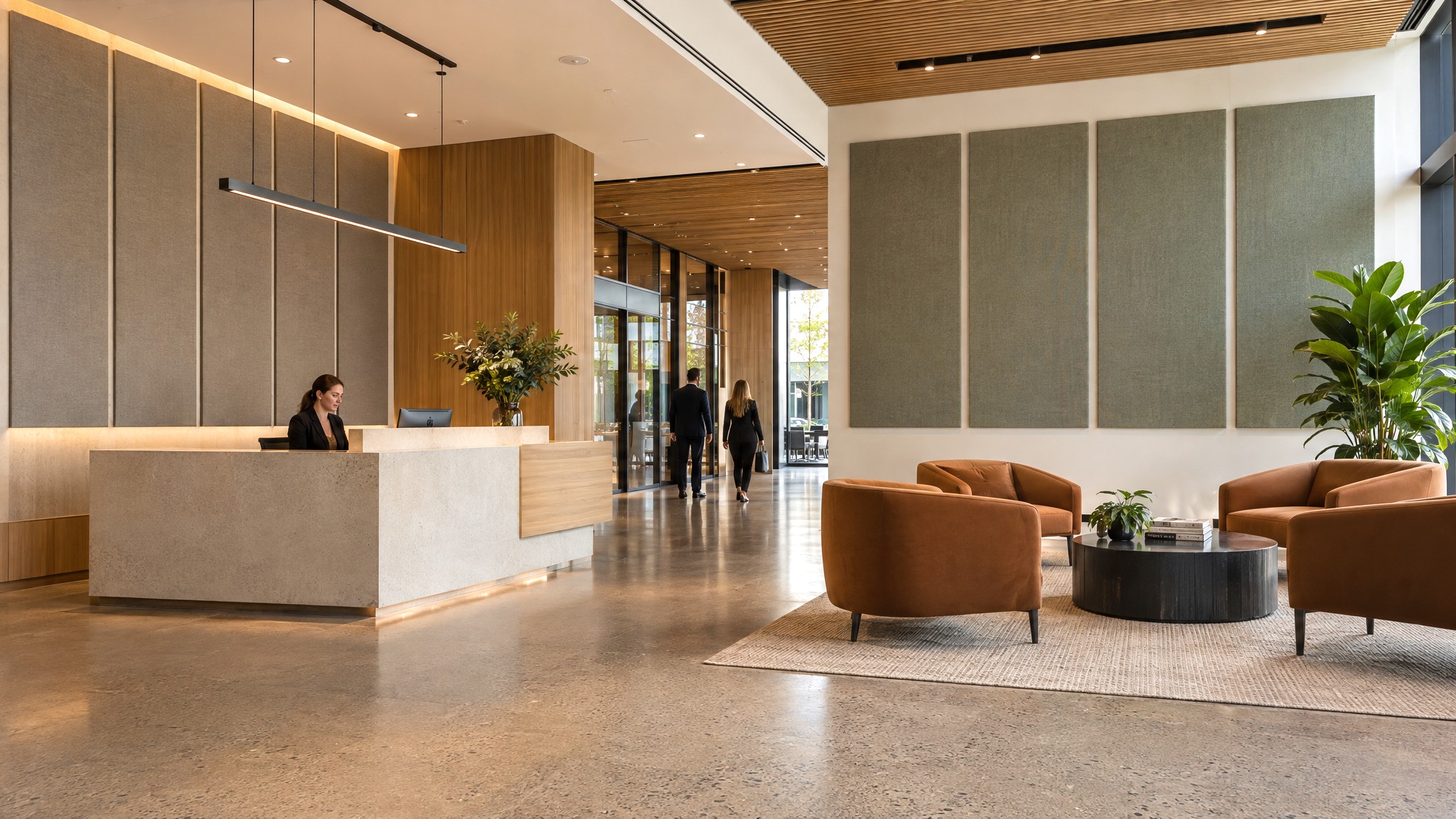
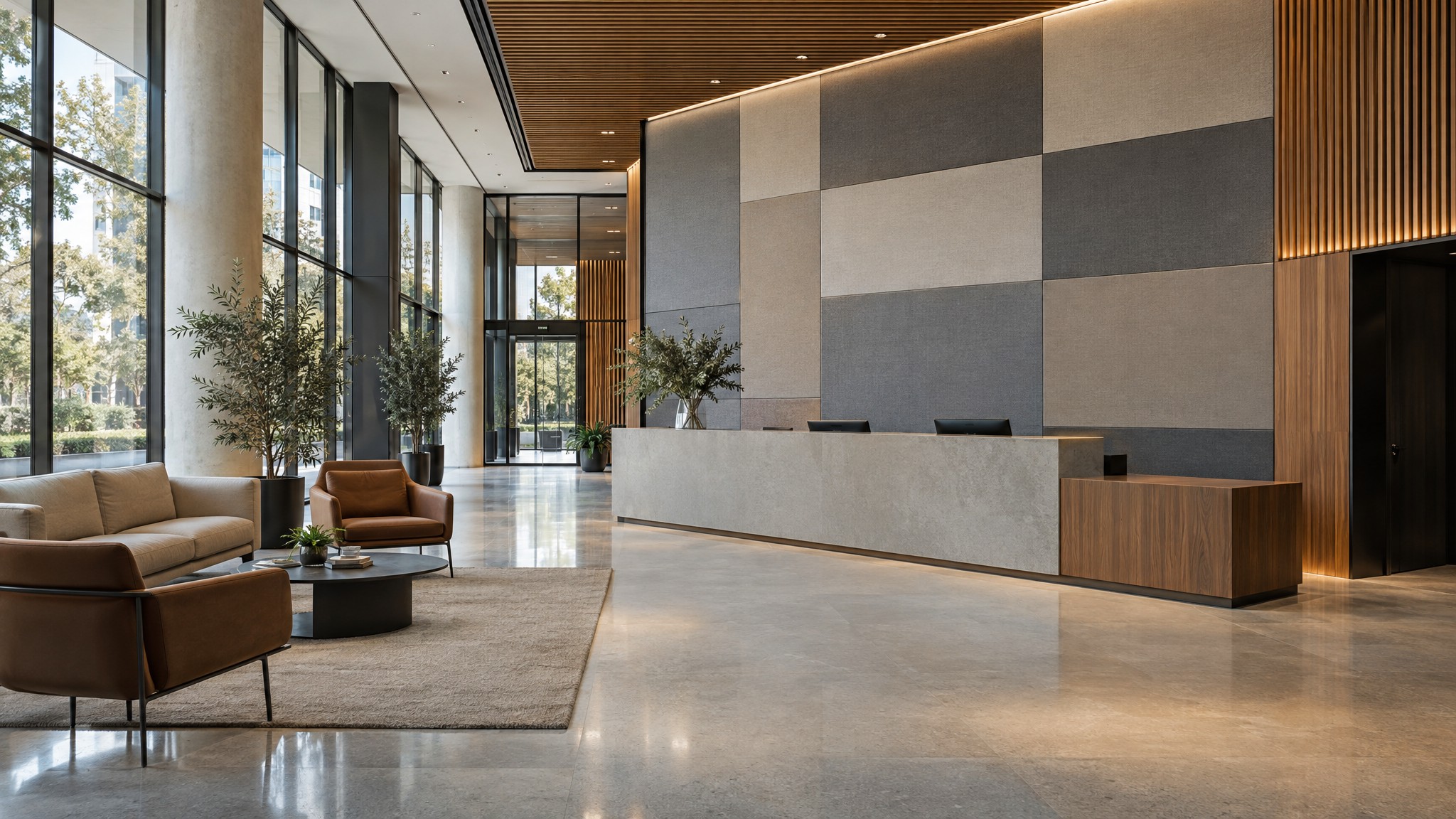
There is no single acoustic panel suitable for every commercial space. Wall-mounted fabric panels may suit meeting rooms, restaurants and reception areas, while ceiling panels and baffles can provide additional absorption in larger open spaces. Timber and decorative acoustic systems may be preferred where the acoustic treatment forms an important part of the architectural design.
The most effective solution considers the room volume, surface finishes, occupancy, available wall and ceiling area and the acoustic requirements of the space.
.
Why Commercial Spaces Become Acoustically Difficult
Many contemporary commercial environments contain large areas of sound-reflective materials and relatively few soft surfaces.
The acoustic problem often becomes more noticeable as occupancy increases. Conversations, telephones, background music, equipment and general activity combine with reflected sound to increase the overall noise level.
Common problems include:
- Excessive reverberation and echo
- Poor speech clarity
- Conversations carrying across large spaces
- Increasing background noise during busy periods
- Difficulty communicating at reception or service counters
- Background music becoming unclear or overpowering
- Acoustic fatigue for staff working for extended periods
- Noise travelling between different activity zones
Large foyers, restaurants, offices, retail stores, convention facilities and other open commercial interiors can be particularly affected where ceiling heights are substantial or where exposed ceilings are part of the design.
How Commercial Acoustic Panels Improve Sound Absorption
Acoustic panels absorb a proportion of the sound energy that reaches their surface rather than allowing that energy to reflect back into the room.
Increasing the amount of effective sound-absorbing surface within a commercial interior can reduce reverberation and help control the build-up of background noise.
Acoustic treatment can be incorporated into:
- Feature walls
- Reception and waiting areas
- Meeting and conference rooms
- Open commercial work areas
- Restaurant and hospitality interiors
- Retail and showroom environments
- Suspended ceiling systems
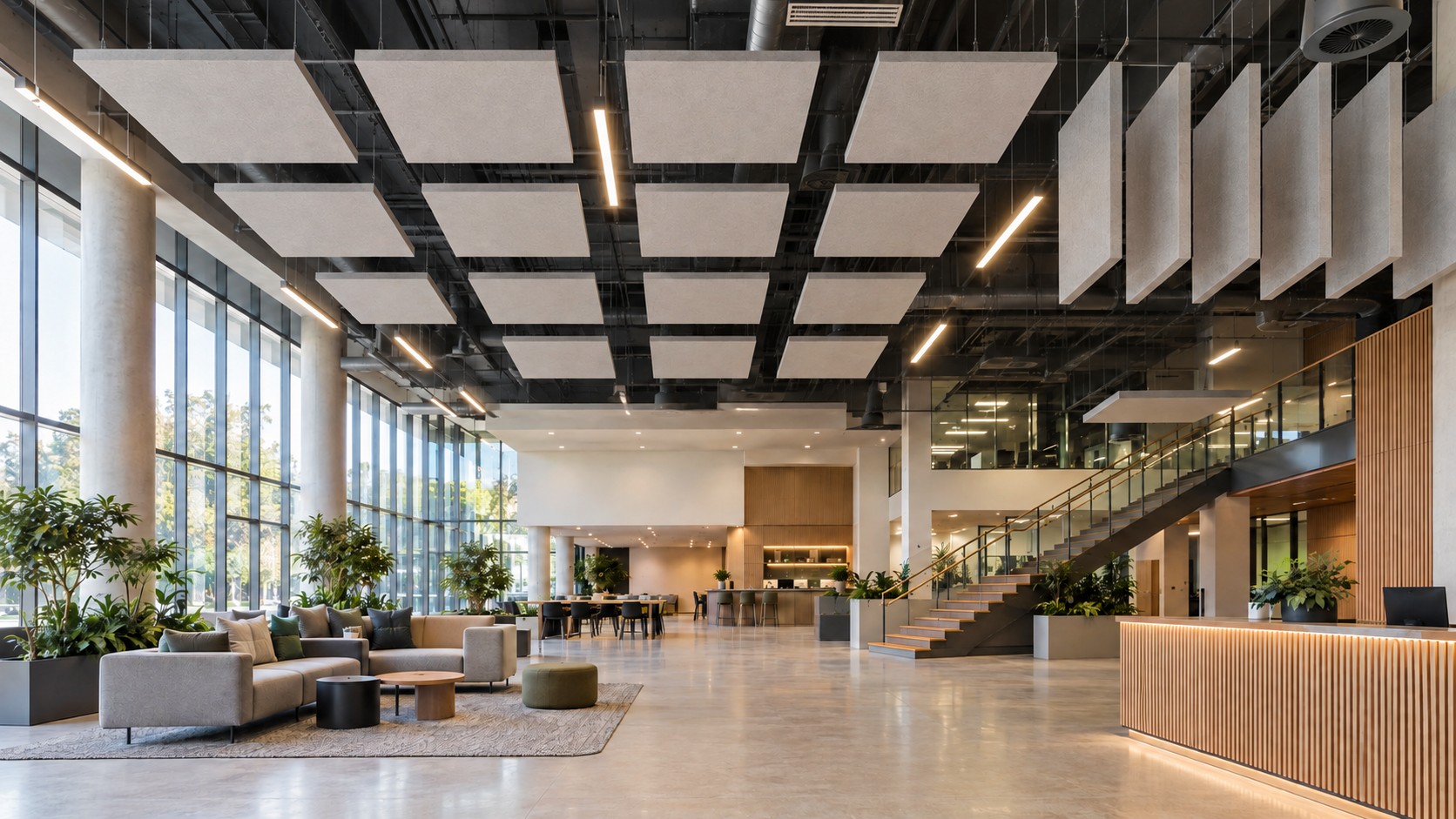
- Ceiling clouds and baffles
Wall and ceiling absorption can also be combined where a larger amount of acoustic treatment is required.
The objective is not necessarily to make the space quiet. Good acoustic design controls unwanted reflections so that normal conversation, music and activity can occur at appropriate levels.
Commercial Acoustic Panel Applications
| Commercial Space | Typical Acoustic Issue | Possible Treatment | Potential Benefit |
|---|---|---|---|
| Offices | Speech and workplace noise travelling through open areas | Wall panels, ceiling panels and baffles | Reduced reverberation and improved comfort |
| Restaurants & Cafés | High conversation levels and hard interior finishes | Wall and ceiling acoustic treatment | Improved dining comfort and speech clarity |
| Retail & Showrooms | Reflections from glazing, flooring and displays | Fabric wall panels and ceiling treatment | More controlled customer environment |
| Reception & Foyers | Large open volumes and high visitor activity | Decorative wall and ceiling panels | Reduced background noise and improved communication |
| Meeting & Conference Rooms | Echo and poor speech intelligibility | Targeted wall and ceiling absorption | Clearer meetings and presentations |
| Large Commercial Venues | Large room volume and long reverberation | Large-format wall panels, clouds and baffles | Greater overall sound absorption |
Sontext Commercial Acoustic Panel Solutions
Commercial interiors vary considerably in size, design and acoustic requirements. Sontext provides several acoustic panel systems that allow designers to select a solution appropriate to both the acoustic and architectural brief.
Serenity Fabric Acoustic Panels
Serenity Fabric Acoustic Panels provide high-performance sound absorption with a decorative fabric finish. They can be used on walls and ceilings and are available in a range of thicknesses, sizes and fabric finishes.
Acoustic Ceiling Panels and Baffles
Suspended acoustic panels, clouds and baffles can introduce additional absorption where walls contain glazing, displays, furniture or other architectural elements.
Murano Timber Acoustic Panels
Where natural timber is an important part of the interior design, perforated or grooved acoustic timber panels can combine architectural wall or ceiling finishes with sound absorption.
Decrasound Polyester Acoustic Solutions
Polyester acoustic panels and screens provide another lightweight option for commercial spaces where colour, durability and design flexibility are important.
What Designers Should Consider When Selecting Commercial Acoustic Panels
Effective commercial acoustic treatment should begin with the room and the acoustic problem rather than simply selecting a panel based on appearance.
Important considerations include:
- Room dimensions and ceiling height
- Amount of glass, concrete, timber and other reflective surfaces
- Expected occupancy
- Type of activity within the space
- Background music or amplified sound
- Available wall and ceiling area
- Required acoustic performance
- Panel thickness and construction
- Lighting, mechanical services and sprinklers
- Fabric, timber or other architectural finishes
- Fire performance and project compliance requirements
Panel thickness can also influence acoustic performance. Where broader-frequency absorption is required, a thicker panel or different mounting arrangement may be appropriate.
For large or acoustically complex commercial spaces, the treatment should be coordinated with an acoustic consultant where required.
.
Creating More Comfortable Commercial Environments
The acoustic environment influences how people experience a commercial interior.
Where reverberation is excessive, occupants may need to speak more loudly and background noise can progressively increase. Appropriate sound absorption can help create a more controlled environment.
Potential benefits include:
- Reduced reverberation
- Improved speech clarity
- Lower build-up of background noise
- More comfortable customer and visitor environments
- Better conditions for meetings and presentations
- Improved clarity of background music and announcements
- Reduced acoustic fatigue for employees
- Better separation between different activity areas
Good commercial acoustics should support the purpose of the space without dominating the visual design.
Commercial Acoustic Panels for New Fitouts and Existing Buildings
Commercial acoustic panels can be incorporated into a new interior fitout or installed retrospectively where an existing space has excessive reverberation.
For new projects, acoustic treatment can be coordinated with:
- Wall finishes
- Ceiling systems
- Lighting
- Air-conditioning
- Sprinklers and other services
- Furniture and joinery
- Brand colours and finishes
In an existing building, wall-mounted panels can often be added without major structural alterations. Ceiling clouds and baffles can also provide useful additional absorption where wall space is unavailable.
This makes acoustic treatment suitable for both complete commercial refurbishments and targeted improvements to existing problem areas.
Find the Right Acoustic Solution for Your Commercial Space
Sontext manufactures acoustic wall and ceiling systems for offices, retail, hospitality, meeting spaces, public areas and other commercial interiors.
Explore the Sontext acoustic panel range or contact our team to discuss the most suitable panel type, thickness, finish and installation method for your project.
Frequently Asked Questions About Commercial Acoustic Panels
What are commercial acoustic panels?
Commercial acoustic panels are sound-absorbing wall or ceiling products designed to reduce reflected sound and reverberation in offices, retail stores, restaurants, meeting rooms, foyers and other commercial interiors.
Where should acoustic panels be installed in a commercial space?
Panels can be installed on walls or ceilings depending on the room layout and available surfaces. Common locations include feature walls, meeting areas, reception spaces and ceilings above larger open areas.
Do thicker acoustic panels absorb more sound?
Panel thickness can influence acoustic performance, particularly at lower frequencies. The most suitable thickness depends on the required performance, panel construction and installation method.
Can commercial acoustic panels be decorative?
Yes. Acoustic panels can be finished in fabric, timber and other architectural finishes, allowing sound absorption to be incorporated into the overall interior design.
Can acoustic panels be retrofitted into existing commercial buildings?
Yes. Wall-mounted panels, suspended ceiling panels and acoustic baffles can often be installed in existing interiors without major structural alterations.